
Activities That Help People Living with Dementia
Families often ask us what they can do with a parent who has dementia. They want to help, to connect, to fill the long afternoons with something better than the television. And underneath the question there's usually a hope that the right activity might somehow hold the disease back.
Let's be honest about that part first, because it matters. Activities for someone with dementia aren't a treatment, and we'd never promise a family that puzzles or music will slow the illness. What good activities do (and this is no small thing) is give a person calm, connection, dignity, and moments of real joy in a day that can otherwise feel empty or frightening. That's the goal. Not fixing. Reaching.
Here's what we've seen actually work.
Music Reaches When Words Can't
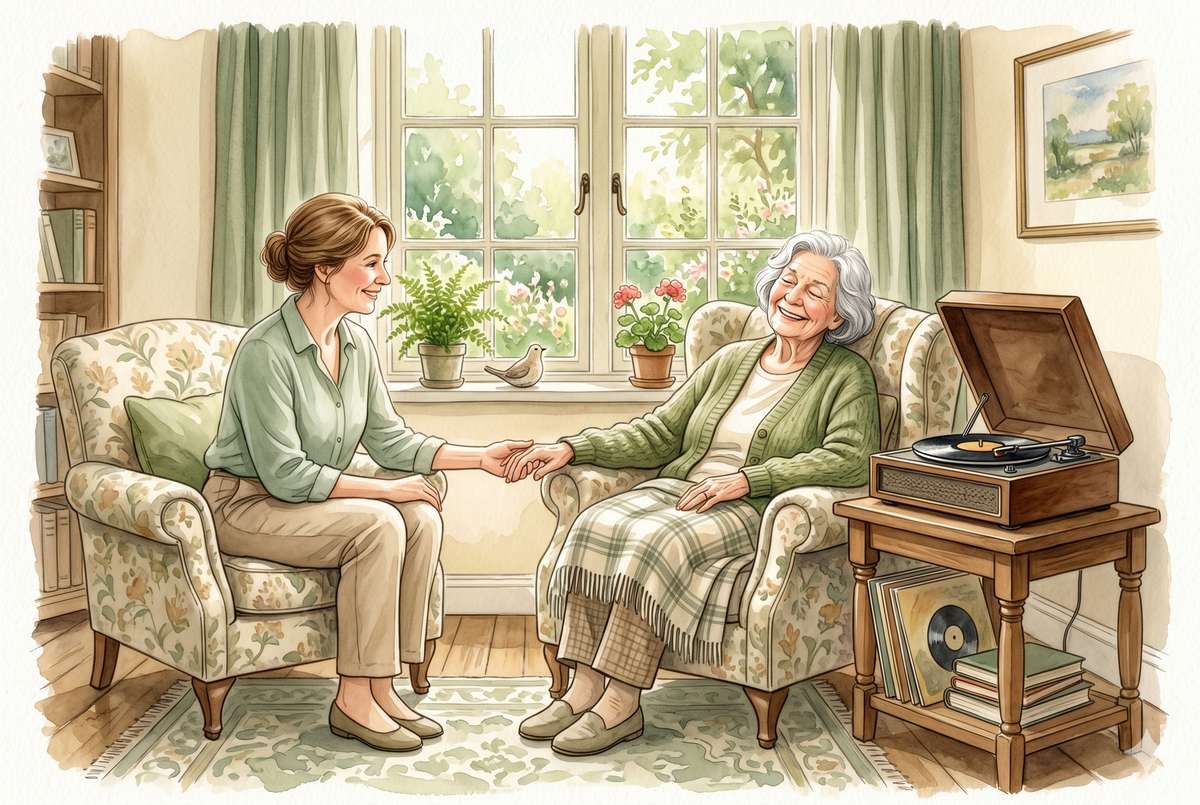
If we could recommend only one thing, it would be music. Long after names and dates have slipped away, the songs of someone's youth are often still right there. Put on the music your mom loved at twenty and you may watch her face change: a foot tapping, lips moving to lyrics she hasn't sung in decades, a calm settling over someone who was agitated a moment ago.
Make a playlist of music that was familiar and loved. That often means the songs of their teens and twenties, but the test is what they enjoyed, not what the decade says they should have. Use it in the hard moments: the restless late afternoon, the anxious evening.
One practical thing families miss: give the music a quiet room to land in. The Alzheimer's Association's guidance is to eliminate the competing noise first, shutting the door, turning off the television, keeping the volume down. Music layered over a loud room is one more thing to sort out, not a relief. Done right, it is one of the most reliable tools we have for bringing someone back to ease.
You don't need anything fancy to do this. A phone, a small speaker, an old radio tuned to the right station, or hymns on a Sunday morning all work. And singing together counts double, because the familiar words and the shared moment both do their quiet good, even on a day when conversation has become hard.
Purposeful, Failure-Free Tasks
People who spent their whole lives being useful often ache to still be useful. The trick is offering tasks that have a purpose but no way to get them "wrong."
Folding a basket of towels. Sorting buttons, rolling coins, putting a deck of cards back in order. Snapping green beans before dinner. Watering plants. Winding yarn. The point isn't the towels. It's the feeling of contributing, of hands busy with something that matters. Avoid anything that can become a test, because failing at something used to be easy is painful. The activity should let them succeed every time. And keep it adult. The Alzheimer's Association's line is to avoid anything that might be demeaning or seem childlike, which is worth holding yourself to, because the easiest failure-free tasks are often the ones that drift closest to a nursery.
The Past Is Easier Than the Present
In dementia, older memories usually outlast recent ones, so activities that reach into the past tend to land well. This is what people mean by reminiscence.
Look through old photo albums together. Ask about their childhood home, their first job, how they met their spouse, and let them tell it their way, even if the details drift. Familiar objects from their era, old songs, a favorite recipe, the smell of bread baking. You're not quizzing them on the past; you're visiting it with them, somewhere they can still feel at home.
The Senses and the Body
When thinking gets harder, the senses still offer a way in. A gentle hand massage with lotion. A soft blanket, a warm towel, textures to touch. The smell of coffee or cinnamon. These small sensory moments can be deeply soothing.
And don't underestimate simple movement. A short walk, gentle stretching, tossing a soft ball back and forth, swaying to music. Bodies that move tend to sleep better and feel calmer. Put the energetic part of the day early, though. The National Institute on Aging's advice for sleep trouble in dementia is to plan the activities that use the most energy early in the day, limit dozing late in the day, and keep the evening quiet and low-lit. That is the opposite of saving the big walk for four in the afternoon, which is the window restlessness tends to arrive in anyway. In a Michigan winter when going outside is hard, even moving around indoors helps, and when the weather allows, time outside (a little sun, a garden, birds at a feeder) is good for almost everyone.
Meet Them Where They Are
The single most important principle runs through all of it: meet the person where they are today, not where they were last year. What works will change as the disease changes. An activity that delighted them in spring may frustrate them by fall, and that's not a failure. It's a cue to adjust.
Keep it short and unpressured. Follow their mood. If something isn't landing, let it go without making it a big deal. And remember that sometimes the best "activity" is simply your presence: sitting together, holding a hand, being unhurried. Connection doesn't require a craft project. Often it just requires showing up and slowing down.
This is a lot of what daily life looks like in our homes. Not a rigid schedule of programmed events, but a rhythm of small, human things: music in the living room, a hand in the dinner prep, an old story, a walk when the sun's out. The goal is never to fix what can't be fixed. It's to make sure the day holds warmth, and the person in it feels known.
If you're caring for a loved one with dementia in the Troy, Michigan area and want to talk about what good days can still look like, we're here. Golden Pines Senior Living serves families across Oakland and Macomb County. Call (248) 266-2738 or email troygoldenpines@gmail.com.