
Assisted Living vs. Memory Care: What's the Difference?
A family called us last year from Bloomfield Hills. Their mother had been living in a large assisted living community for about eighteen months. Things had been going well at first, but over the past few months, she had started wandering. She left the building twice. Staff found her in the parking lot both times, confused and upset. The facility told the family she needed to move to their memory care unit — a different floor, different staff, higher cost.
The family was blindsided. They did not fully understand what memory care was, how it was different from the assisted living their mother was already receiving, or why the move was necessary. They felt rushed into a decision.
I hear versions of this story often. So let me explain the difference between assisted living and memory care — clearly, practically, and honestly.
What Each One Provides
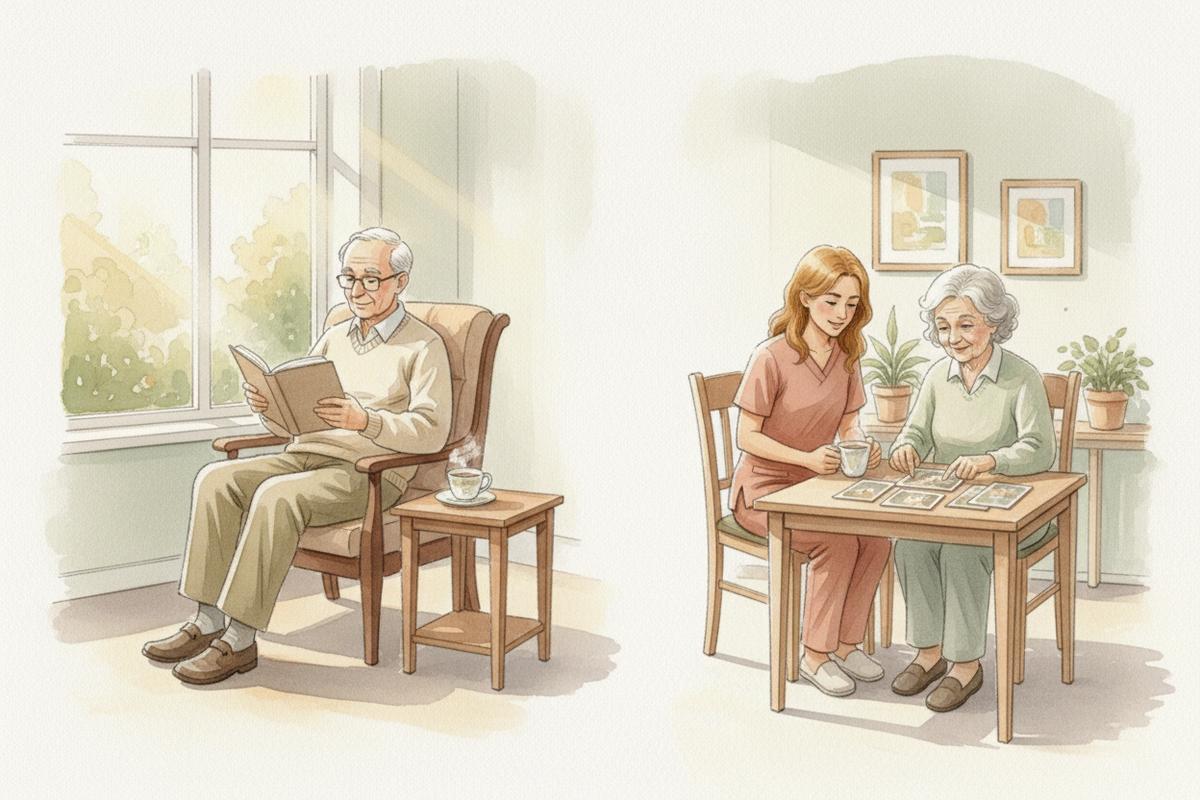
Assisted living is for people who need help with daily activities but are cognitively intact or have only mild cognitive decline. Help with bathing, dressing, meals, medications, getting around. The goal is to support independence. Residents generally come and go as they please, make their own decisions about how to spend their day, and live in a relatively open environment.
Memory care is for people with Alzheimer's disease, dementia, or other significant cognitive impairment. It includes everything assisted living provides, plus a layer of specialized care designed specifically for people whose minds are not reliable. That means secured environments to prevent wandering, staff trained in dementia-specific behaviors, structured routines that reduce confusion, and activities designed to engage whatever cognitive function remains.
The line between them is not always crisp. A person in the early stages of dementia might do perfectly well in an assisted living setting, especially a small one with attentive staff. A person in the middle or later stages probably needs the structure and security that memory care provides.
The Environment
This is where the two settings diverge most visibly.
In a standard assisted living community, the layout is open. Residents have apartments or rooms. They walk to the dining room, the common areas, the front door. There are multiple exits, and residents are free to use them. It feels like an apartment building or a residential community because that is what it is.
A memory care environment is different by design. Exits are secured — coded doors, alarms, sometimes disguised exits that reduce the impulse to leave. The layout is simplified. Hallways loop rather than dead-end, because a person with dementia who hits a dead end gets frustrated and agitated, while a person who walks a loop eventually arrives back where they started without distress. Rooms are easier to identify. Clutter is minimized. The whole space is built around reducing confusion.
In a large facility, memory care is often a separate wing or floor. You take an elevator or pass through a locked door and you are in a different world — different staff, different residents, different atmosphere. That separation can feel isolating for both the resident and the family.
In a small home, the distinction works differently. A home like ours can serve residents with dementia alongside residents who are cognitively intact, in the same house, at the same table. This works because the staff-to-resident ratio is small enough that everyone gets individual attention. A caregiver who is responsible for six people can know each of them deeply — their habits, their triggers, their good hours and their bad hours. That kind of personalized attention is what memory care is supposed to be about, and in a small home, it happens naturally.
Staffing
In a large memory care unit, the staff-to-resident ratio is typically around one caregiver for every five or six residents during the day. That is better than standard assisted living, where the ratio might be one to eight or one to fifteen. At night, memory care ratios often drop to one to eight or one to ten.
The staff in memory care units receive specialized training in how to communicate with people who have cognitive impairment, how to manage behaviors like agitation and aggression, how to redirect someone who is confused or frightened without making things worse. This training matters. A caregiver who tells a confused resident "Don't you remember? I told you five minutes ago" is doing harm, even if they do not mean to.
In a small home, the ratio is inherently better. With six residents and two caregivers, you are looking at one to three. You do not need a specialized wing because the specialization is built into the daily relationship between caregiver and resident.
Cost
Memory care costs more than standard assisted living. How much more depends on where you are.
In Michigan, the median cost of assisted living is about $6,040 per month. Memory care runs roughly $6,500 to $7,400 per month at larger facilities — a premium of about $750 to $1,300 per month. Some luxury memory care communities charge significantly more.
Small adult foster care homes providing memory-level care in Michigan often cost less than the dedicated memory care units at large facilities, though the range varies depending on location, staffing, and level of care. Families are often surprised to learn that a small home with better staff-to-resident ratios can be competitive in price with a large community that offers less personal attention.
The cost difference between assisted living and memory care in a large facility reflects the higher staffing ratios and the specialized environment. In a small home, those things are already built in, which is why the price difference is less dramatic.
Michigan Licensing — An Important Detail
Here is something most families do not know: Michigan does not have a separate license for memory care. There is no state-regulated category called memory care. The licensing categories are adult foster care and Home for the Aged, and both can serve residents with dementia.
When a facility in Michigan markets itself as a "memory care community," that describes the services they offer, not a license they hold. The state does require that any facility advertising Alzheimer's or dementia care must disclose its care philosophy, the services it provides for dementia residents, its physical environment, and its staff training program. But there is no additional license required.
What this means for your family: when you are evaluating a memory care option, look beyond the label. Ask about the actual training the staff receives. Ask how many residents the home or unit serves and how many caregivers are on each shift. Ask what happens when a resident is having a bad day — not the textbook answer, the real one.
When Does Someone Need to Move from Assisted Living to Memory Care?
This is the question that keeps families up at night. There is no single answer, but there are clear signs:
Wandering. If your loved one is leaving the building or trying to, they need a secured environment. This is often the tipping point.
Safety incidents. Falls that happen because the person is confused about their surroundings. Attempting to cook or use appliances unsafely. Taking medications incorrectly despite supervision.
Behavioral changes. New aggression, paranoia, or combativeness that the current care team cannot safely manage.
Significant decline in daily function. When standard assisted living support is not enough — when the person needs constant guidance through every task, not just help.
Sundowning. Increasing confusion and agitation in the late afternoon and evening that disrupts the person's wellbeing and sometimes the wellbeing of other residents.
If any of these are happening, it is time to talk to the care team about whether the current setting still fits. A good care home — whether large or small — will be honest with you about this. We have had that conversation with families ourselves, and while it is never easy, it is always better than waiting for something to go seriously wrong.
What We Do at Golden Pines
We serve residents with dementia in our homes alongside residents without cognitive impairment. We can do this because our homes are small enough that every resident gets individual attention, and our caregivers develop the kind of deep familiarity with each person that is the real foundation of memory care.
We are honest with families about our limits. If a resident's dementia progresses to the point where they need a fully secured environment or a level of medical care we cannot provide, we will tell the family. We would rather help a family find the right next step than keep a resident in a setting that no longer serves them well.
If you are trying to figure out whether your loved one needs assisted living, memory care, or something in between, call us at (248) 266-2738 or email troygoldenpines@gmail.com. We have been through this conversation with many families, and we are happy to help you think it through — even if the answer turns out to be somewhere other than Golden Pines.