
Assisted Living vs. Nursing Home: What's the Difference?
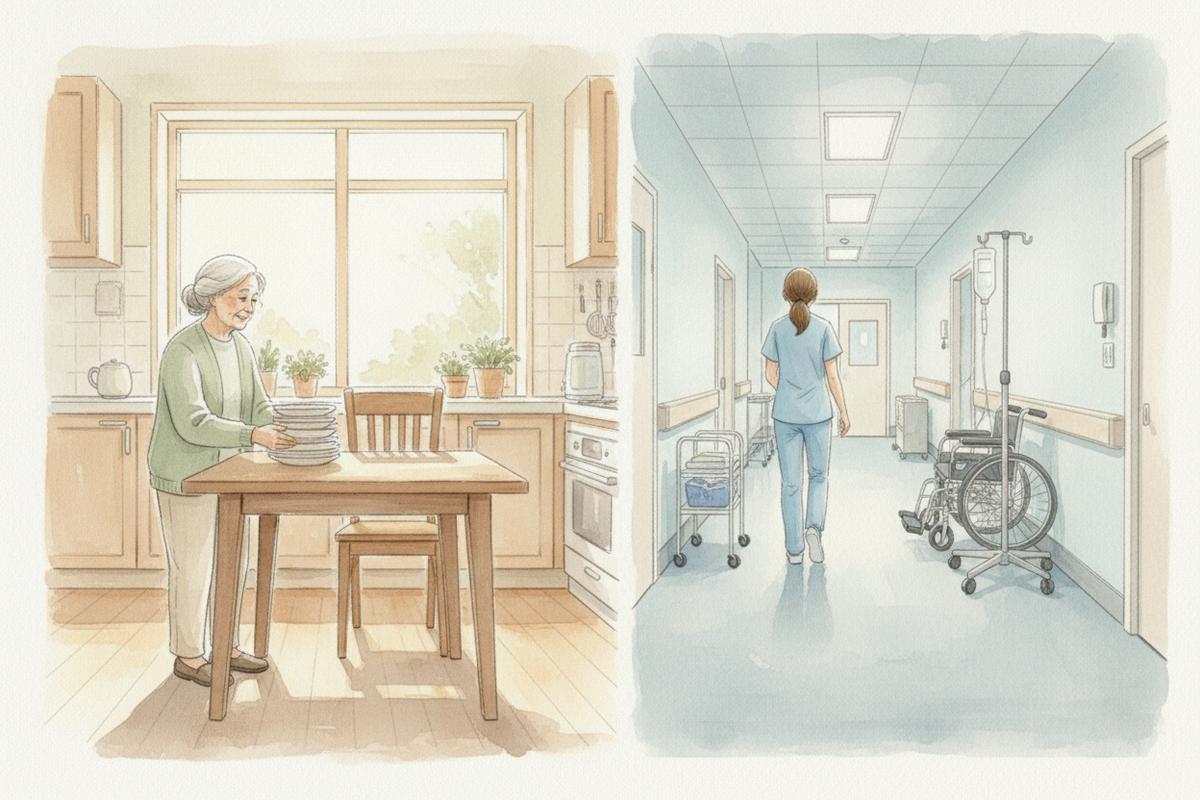
Most families start their search with a question that seems straightforward: what is the difference between assisted living and a nursing home? The answer matters more than you might think, because these are genuinely different types of care — and choosing the wrong one can mean your loved one ends up in a setting that does not fit their needs.
We hear this question all the time. A family calls us, sometimes from Rochester Hills or somewhere else in the Troy area, and they say: "We think Mom needs a nursing home." And nine times out of ten, what Mom actually needs is assisted living. The terms get used interchangeably in everyday conversation, but they should not be, because the experience of living in each one is very different.
What Assisted Living Actually Is
Assisted living is for people who need help with daily life but do not need round-the-clock medical care. That help might include things like getting dressed, bathing, managing medications, preparing meals, and getting to appointments. The goal is to support independence — to step in where a person needs it and step back where they do not.
In Michigan, small assisted living homes like ours are licensed as adult foster care homes under the state's Department of Licensing and Regulatory Affairs (LARA). The term sounds clinical but the reality is anything but. An adult foster care home is a residential home — an actual house in an actual neighborhood — where a small number of residents live together and receive personalized care.
That is what Golden Pines is. Two homes in Troy, each with a small number of residents, staffed by caregivers who know every person by name. The environment feels like a home because it is one.
What a Nursing Home Is
A nursing home, also called a skilled nursing facility, provides a higher level of medical care. Residents in nursing homes typically need ongoing medical attention — things like wound care, IV therapy, physical rehabilitation after surgery, or management of complex medical conditions that require licensed nurses on site at all times.
Nursing homes are larger, more clinical settings. They have medical equipment, nursing stations, and staff trained to handle acute health needs. For someone who needs that level of care, a nursing home is the right place.
But here is the thing: most seniors do not need that level of care. The majority of older adults who can no longer live safely on their own need help with daily activities, not hospital-level medical supervision. And placing someone who needs assisted living into a nursing home means they end up in an environment that is more institutional, more restrictive, and more expensive than what their situation requires.
The Key Differences
Level of care. Assisted living focuses on help with daily living — meals, medications, bathing, dressing, mobility. Nursing homes provide skilled medical care around the clock.
Environment. Assisted living, especially in a small home like ours, feels residential. You are living in a house. Nursing homes feel more like medical facilities, because that is what they are.
Staffing. In a small assisted living home, caregivers develop real relationships with residents. In a nursing home, the staff-to-resident ratio is often higher in numbers but lower in personal connection because the focus is on medical tasks.
Cost. Nursing homes are significantly more expensive than assisted living. In Michigan, the average cost of a nursing home can be two to three times what assisted living costs. If your loved one does not need skilled nursing care, there is no reason to pay for it.
Independence. Assisted living preserves as much independence as possible. Residents make their own choices about how they spend their day. Nursing homes, by necessity, operate on more structured schedules driven by medical needs.
How to Know Which One Your Loved One Needs
The question comes down to medical needs. If your loved one requires skilled nursing — things like complex wound care, IV medications, ventilator management, or intensive physical rehabilitation — a nursing home is the right fit.
If your loved one needs help with the activities of daily life but is otherwise medically stable, assisted living is almost certainly the better option. It is less institutional, more personal, and it allows your loved one to maintain a sense of normalcy and dignity that is hard to replicate in a larger clinical setting.
If you are unsure, talk to your loved one's doctor. And talk to us. We have had honest conversations with hundreds of families over the years, and we will tell you straight whether Golden Pines is the right fit or whether your loved one needs a higher level of care. We would rather point you in the right direction than take on a resident whose needs we cannot meet.
Why It Matters
The difference between assisted living and a nursing home is not just a technicality. It shapes every part of your loved one's daily experience — where they sleep, what they eat, who they see, how they spend their time, and how they feel about the place they live.
We have seen what happens when someone who needs a home ends up in a facility. They withdraw. They lose the spark that makes them who they are. And we have seen what happens when that same person moves into a place like Golden Pines — a real house, with real food, and real people who care. They come back to life.
That is not an exaggeration. It is what we see, over and over, in our homes in Troy.
If your family is trying to figure out the right type of care for someone you love, we are happy to help you think it through. Call us at (248) 266-2738 or email troygoldenpines@gmail.com.