
Tips for Visiting a Loved One with Memory Loss
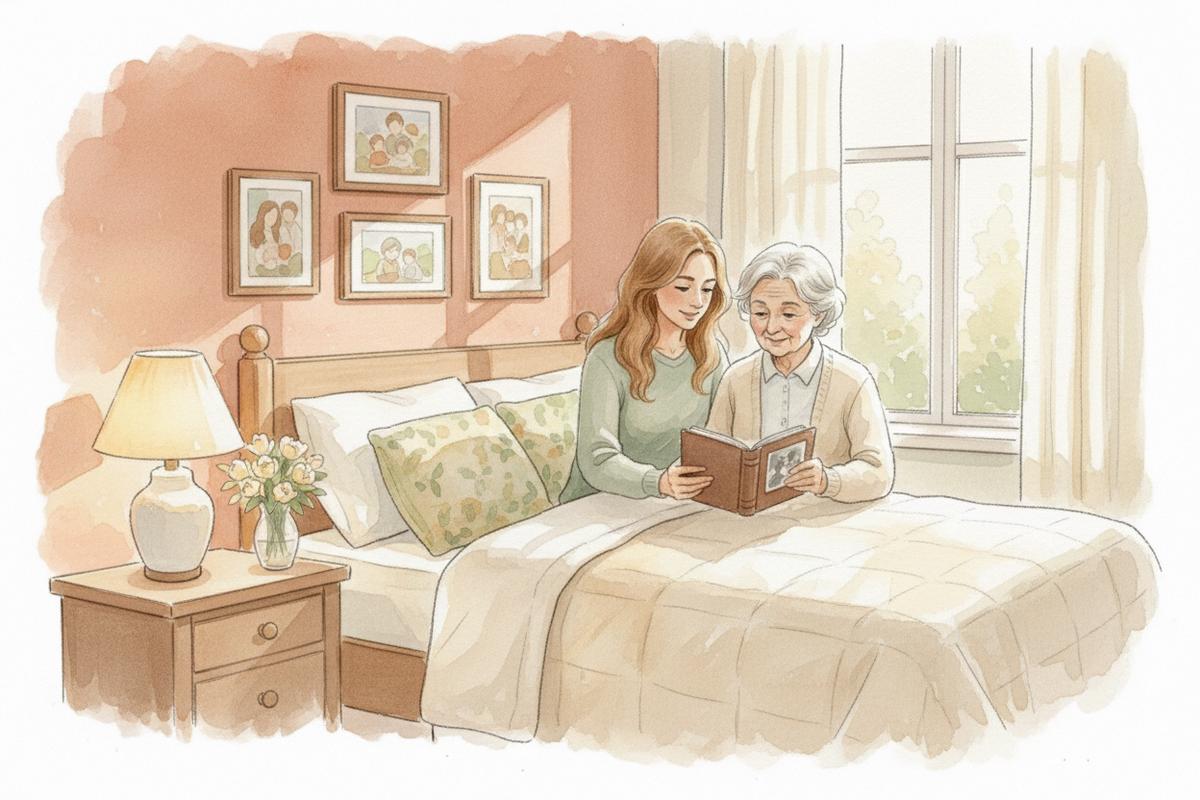
A daughter drove over from Sterling Heights last fall to visit her mother at Herbmoor House. She had not been in a week, and she was nervous. Her mother's memory had been slipping faster in recent months, and the last visit had been difficult — her mother had called her by her sister's name and then gotten upset when corrected.
This time, the daughter walked in and sat down next to her mother in the sunroom. She did not say anything at first. She just took her mother's hand. Her mother looked at her for a long moment and said, "You have warm hands." That was the whole conversation for the first five minutes. And it was one of the best visits they had ever had.
I tell this story because it captures something about visiting a loved one with memory loss that is hard to put into words. The visit does not have to look the way you think it should. It does not need dialogue or recognition or a meaningful exchange. Sometimes it just needs presence.
What Good Visits Look Like Here
After years of watching families visit residents in our homes, I have noticed that the visits that go best share a few things in common. None of them have to do with what you say.
The best visits happen when the family member arrives without an agenda. They are not trying to have a specific conversation or share specific news or get a specific response. They are just there. They sit. They hold a hand. They look at the same window their parent is looking at. And something passes between them that has nothing to do with words.
I watched a son visit his father every Sunday for a year. His father had advanced Alzheimer's and no longer recognized him consistently. The son would come in, sit next to his dad on the couch, and turn on the Tigers game. They would watch together in silence for an hour. Sometimes his father would say something about the game that made perfect sense. Sometimes he would not say anything at all. But every time the son left, his father seemed calmer, and the son told me once that those Sunday afternoons were the closest he felt to his dad anymore.
That is what a good visit looks like. Not a Hallmark moment. Just two people sharing space.
Timing Matters More Than You Think
One of the most practical things you can do is pay attention to when you visit. People with dementia often have a rhythm to their day that is not obvious from the outside but becomes clear once you know what to look for.
Mornings tend to be the best time for most of our residents. After a good night's sleep and a solid breakfast, the mind is usually at its clearest. This is when recognition is most likely, when conversation flows most naturally, and when your loved one is most likely to be engaged and alert.
Late afternoon and evening are harder. There is a pattern called sundowning that affects many people with dementia — as the light fades, confusion and agitation tend to increase. A resident who was perfectly pleasant at noon might be restless and distressed by five. This is not about you. It is not about the visit. It is about the disease, and it is predictable enough that you can plan around it.
Our caregivers know each resident's rhythm well. If you are not sure when to visit, ask us. We will tell you honestly when your loved one tends to be at their best.
What to Bring
The best things you can bring on a visit are not expensive or complicated. They are sensory. Memory loss takes away a person's ability to process abstract information — names, dates, recent events — but it often leaves the senses remarkably intact.
Music works better than almost anything else. If your loved one has a song or a type of music they loved, play it on your phone. We have seen residents who cannot carry on a conversation sing along to every word of a song from 1958. Music lives in a different part of the brain than language, and dementia often leaves it untouched.
Photos can be wonderful if you use them the right way. Instead of asking "Do you remember this?" — which puts pressure on a brain that cannot reliably retrieve memories — try saying, "Look at this picture. That is you and Dad at the lake." Tell the story instead of asking for it. Let your loved one listen and respond however they respond. Sometimes they will add a detail you did not expect. Sometimes they will just smile. Both are worth it.
Food works too. A favorite cookie, a cup of coffee made the way they like it, a piece of fruit. The taste of something familiar can bring a kind of comfort that conversation cannot.
Touch is the most underrated one. Holding a hand, rubbing a shoulder, brushing hair. For a person whose world has become confusing and frightening, physical contact with someone safe can settle everything in an instant. Our caregivers use touch constantly throughout the day, and it is one of the most effective tools we have.
What Not to Do
Do not quiz your loved one. "Do you know who I am?" is a question that serves no purpose except to remind both of you of what has been lost. If they know you, they know you. If they do not, telling them gently is kinder than testing them.
Do not correct their reality. If your mother tells you she needs to pick up the kids from school — kids who are now in their fifties — do not argue. Say, "Tell me about the kids." Or say, "The kids are fine." Meet her where she is. Correcting a person with dementia does not bring them back to your reality. It just makes them feel wrong and confused.
Do not feel guilty about short visits. A twenty-minute visit where you are fully present is worth more than an hour where you are checking your phone and counting the minutes. Come, be there, leave when you feel the natural end. Your loved one will carry the warmth of your presence long after you go.
And do not stop coming. This is the most important one. Families sometimes pull away as the disease progresses because the visits become harder and the recognition fades. I understand that impulse. But your loved one needs you more as the disease advances, not less. Even when they cannot name you, they know you. They know the sound of your voice and the feel of your hand and the way the room changes when you walk into it. Those things matter until the very end.
Seasonal Visit Ideas
Families sometimes ask us what they can do during visits beyond sitting and talking. Here are a few things we have seen work well at different times of year.
In spring and summer, take your loved one outside. Our patio at Herbmoor House is a wonderful spot for a visit. Sit in the sun. Watch the birds. Bring a potted plant and put it on the table between you. The change of scenery from indoors to outdoors often sparks a shift in mood that makes the whole visit better.
In fall, bring something seasonal. Apple cider, a small pumpkin, a few colorful leaves. The smells and textures of autumn are deeply embedded in most people's memories, and they can unlock moments of recognition and pleasure that surprise you.
In winter, visits can be cozier. Bring a warm blanket. Sit by the window and watch the snow. Put on a holiday movie. Winter visits at our homes often end up being the most intimate because the pace is naturally slower and the house is warm and quiet.
We Are Here to Help
Our caregivers are your partners in making visits work. If you are struggling — if the visits are getting harder, if you are not sure what to do, if you are worried about a change you have noticed — tell us. We see your loved one every day. We know their rhythms, their preferences, and their current state. We can help you plan visits that work for both of you.
We work with families from Troy, Sterling Heights, and throughout Oakland and Macomb Counties. If your loved one is at Golden Pines or if you are considering moving them here, we are happy to talk about what visiting looks like and how we can make it as meaningful as possible.
Call (248) 266-2738 or email troygoldenpines@gmail.com.